
Safeguarding checks
Once the court has accepted an application, the next stage is to consider whether there are any immediate safeguarding concerns affecting the child. This process is carried out before the first court hearing and helps the court identify whether there are any issues requiring urgent attention. As part of these enquiries, CAFCASS will usually carry out checks with the police and local authority children's services. The purpose is to establish whether there is any history of domestic abuse, safeguarding concerns, previous social services involvement or other matters that may affect the child's welfare.
A CAFCASS Family Court Adviser will normally telephone both parents before the first hearing. During this conversation they will ask questions about the child's current arrangements, any concerns about safety and whether there is any possibility of reaching an agreement before attending court. These conversations are not designed to determine who is right or wrong. Instead, they allow CAFCASS to identify any risks and provide the court with an initial overview of the family's circumstances. If immediate concerns are identified, the court may decide that additional safeguards are necessary while the case continues.
The safeguarding letter
Following the safeguarding enquiries, CAFCASS prepares a safeguarding letter for the court. This document provides the judge with an initial summary of the information gathered during the police and local authority checks, together with any concerns raised by either parent during their telephone interviews. The safeguarding letter may also include recommendations about how the case should proceed. In straightforward cases, CAFCASS may suggest that parents attempt to reach an agreement at the first hearing. In more complex cases, it may recommend that additional reports or investigations are required. It is important to understand that the safeguarding letter is only an early assessment. It is not the final recommendation and does not determine the outcome of the proceedings.
The role of CAFCASS throughout proceedings
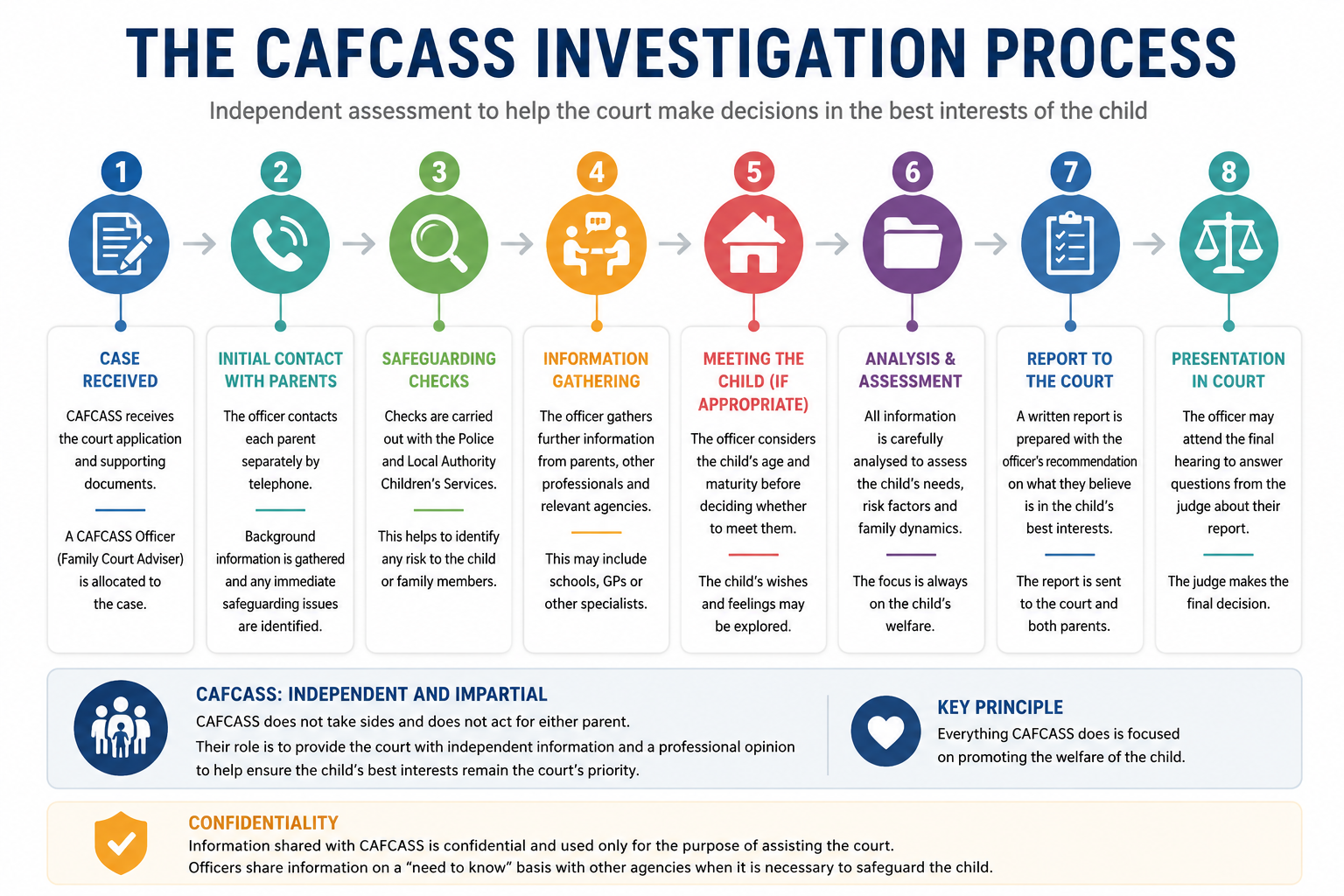
Many parents mistakenly believe that CAFCASS works for the court or represents one of the parents. Neither is correct. CAFCASS is an independent organisation whose responsibility is to promote the welfare of children involved in family proceedings. Depending on the circumstances of the case, a CAFCASS officer may speak to both parents on several occasions, meet with the child where appropriate, obtain information from schools or other professionals, review relevant documents and prepare reports for the court. Their recommendations are often influential because they are based on independent enquiries rather than the views of either parent. However, the judge is not required to follow CAFCASS recommendations. The final decision always rests with the court but the results gained from CAFCASS are highly influential. A fathers solicitor or a barrister will take this into account when writing or influencing the position statement. Please see below image that will explain how CAFCASS achieve the final conclusion based on their family law case investigation.
Why some cases take longer than others
Many parents expect family court proceedings to conclude within a few weeks. In reality, children's cases often take considerably longer. Some cases are resolved after only a small number of hearings, while others continue for many months. Delays can occur for a variety of reasons. The court may require additional evidence, CAFCASS may need time to prepare reports, independent experts may need to carry out assessments or further hearings may be necessary because parents remain unable to agree. The court also has to balance thousands of other family cases within the same court system. Although delays can be frustrating, they do not necessarily indicate that something has gone wrong with your case.
Did you know?
Official figures show that private law children's cases currently take around 41 weeks on average to reach a final order.
Every case is different, and some conclude much sooner while more complex cases may take considerably longer.
Source: Ministry of Justice.
Gathering evidence
As proceedings progress, both parents will usually be expected to provide evidence supporting their position. Family courts rely on evidence rather than assumptions. Evidence may include emails, text messages, school records, attendance reports, medical records, photographs, police records, previous court orders or any other documents that help explain the issues before the court. Good evidence is organised, relevant and directly connected to the matters the judge must decide. Large bundles containing unnecessary documents often make it more difficult for the court to identify the important issues. Quality is far more valuable than quantity.
Writing a witness statement
One of the most important documents during proceedings is the witness statement. This allows each parent to explain the background of the dispute, the child's current circumstances and why they believe the orders they are seeking are in the child's best interests. A good witness statement is clear, factual and supported by evidence wherever possible. Judges generally prefer straightforward explanations rather than emotional language or personal criticism. Where allegations are made, they should be supported by evidence whenever available. Parents sometimes believe that making numerous accusations will strengthen their case. In reality, unsupported allegations may damage credibility if they cannot be substantiated.
Digital evidence
Modern family court cases frequently involve digital evidence. Messages exchanged through WhatsApp, emails, social media communications, photographs, videos and call records may all become relevant depending on the issues before the court. If digital evidence is relied upon, it should normally be presented in its original form wherever possible. Editing screenshots or removing parts of conversations can affect credibility if discovered later. The court expects honesty and transparency from both parties.
Allegations and fact-finding hearings
Not every family court case involves allegations of abuse or harmful behaviour. However, where serious allegations are likely to affect decisions about a child, the court may decide that those allegations need to be determined separately before the case can progress. This is known as a fact-finding hearing. During this hearing both parents give evidence under oath and may be questioned about the disputed events. The judge carefully considers all available evidence before deciding whether each allegation has been proved on the balance of probabilities. These findings may significantly influence later decisions regarding child arrangements.
Independent expert reports
Sometimes the court requires specialist knowledge before reaching a decision. In these situations the judge may authorize an independent expert to prepare a report. Examples include psychologists, psychiatrists, medical specialists, drug and alcohol experts or other professionals with relevant expertise. Experts are instructed to assist the court rather than either parent. Their duty is to provide impartial professional opinions based upon their assessment. The court will carefully consider those opinions alongside all the other available evidence.
Interim orders
Because proceedings often continue for several months, temporary arrangements may be needed while the case remains ongoing. The court has the power to make interim orders dealing with issues such as contact arrangements or other immediate matters affecting the child's welfare. These temporary arrangements provide stability while further evidence is gathered. Importantly, interim orders do not necessarily indicate what the final decision will be. The judge may reach a different conclusion once all of the evidence has been considered.
How judges assess credibility
One of the judge's responsibilities is deciding how much weight should be given to the evidence presented by each party. Credibility is rarely determined by confidence or emotion alone. Judges often look for consistency between witness statements, documentary evidence, text messages, school records and other independent information. Where evidence is consistent over time, it is generally considered more reliable than evidence that changes significantly during proceedings. Parents who acknowledge both strengths and weaknesses in their case are often viewed as more credible than those who insist they have done everything perfectly.
The importance of child-focused behaviour
Family courts expect parents to separate their disagreements from their responsibilities as parents. Judges recognise that relationships break down and emotions can run high. However, they also expect parents to avoid exposing children to adult conflict wherever possible. Parents who encourage positive relationships with the other parent, communicate respectfully and demonstrate flexibility are often viewed more favourably than those who appear focused on conflict or punishment. This does not mean parents should ignore genuine safeguarding concerns. Rather, they should ensure that concerns are supported by evidence and remain focused on the child's welfare rather than personal grievances.
Common mistakes parents make
Many parents unintentionally weaken their own case by making avoidable mistakes during proceedings. Some focus almost entirely on criticising the other parent instead of explaining what arrangements would benefit the child. Others ignore court directions, submit evidence late or fail to attend hearings. Some parents overwhelm the court with hundreds of pages of irrelevant documents while overlooking the key evidence that actually supports their position. Another common mistake is communicating aggressively by text or email during proceedings. Judges may read those communications later, and hostile messages rarely assist a parent's case. Perhaps the most significant mistake is losing sight of the child's needs. The court is not interested in deciding which parent has "won" the dispute. Its responsibility is to determine what arrangements best support the child's long-term welfare.
Practical tips while your case is ongoing
If you are involved in family court proceedings, there are several practical steps that can make the process easier. Keep copies of all important correspondence and organise your documents carefully from the outset. Read every court order thoroughly and make a note of all deadlines. Remain polite in all written communication, even when conversations become difficult. Continue encouraging your child's relationship with the other parent whenever it is safe to do so. Most importantly, focus your evidence on the child's needs rather than the history of the relationship. Parents who remain calm, organised and child-focused are generally in a much stronger position to present their case effectively.