
Going to family court is something most parents never expect to experience. When a relationship breaks down and disagreements arise over children, many parents feel anxious about what lies ahead. Questions such as How long will the process take?, Will the judge listen to me?, What happens at each stage? and Will the court favour the other parent? are extremely common. The good news is that family court is not designed to create winners and losers. Its primary purpose is to make decisions that promote the welfare of the child. Every stage of the process is focused on finding arrangements that are safe, practical and in the child's best interests. Understanding how family court proceedings work can remove much of the uncertainty. When you know what to expect, you can prepare more effectively, understand why certain decisions are made, and avoid many of the mistakes that parents commonly make during proceedings.
This guide explains the entire family court process in England and Wales, from the moment an application is made until the final order is issued. It also explains the role of CAFCASS, the judge, expert witnesses and the evidence that may be considered along the way.
Key facts - Family court at a glance
• Around 270,000 new family court cases were started during 2025.
• Private law children's cases took an average of 41 weeks to reach a final order.
• CAFCASS received 42,172 new private law children's cases between April 2025 and March 2026.
Source: Ministry of Justice and CAFCASS.
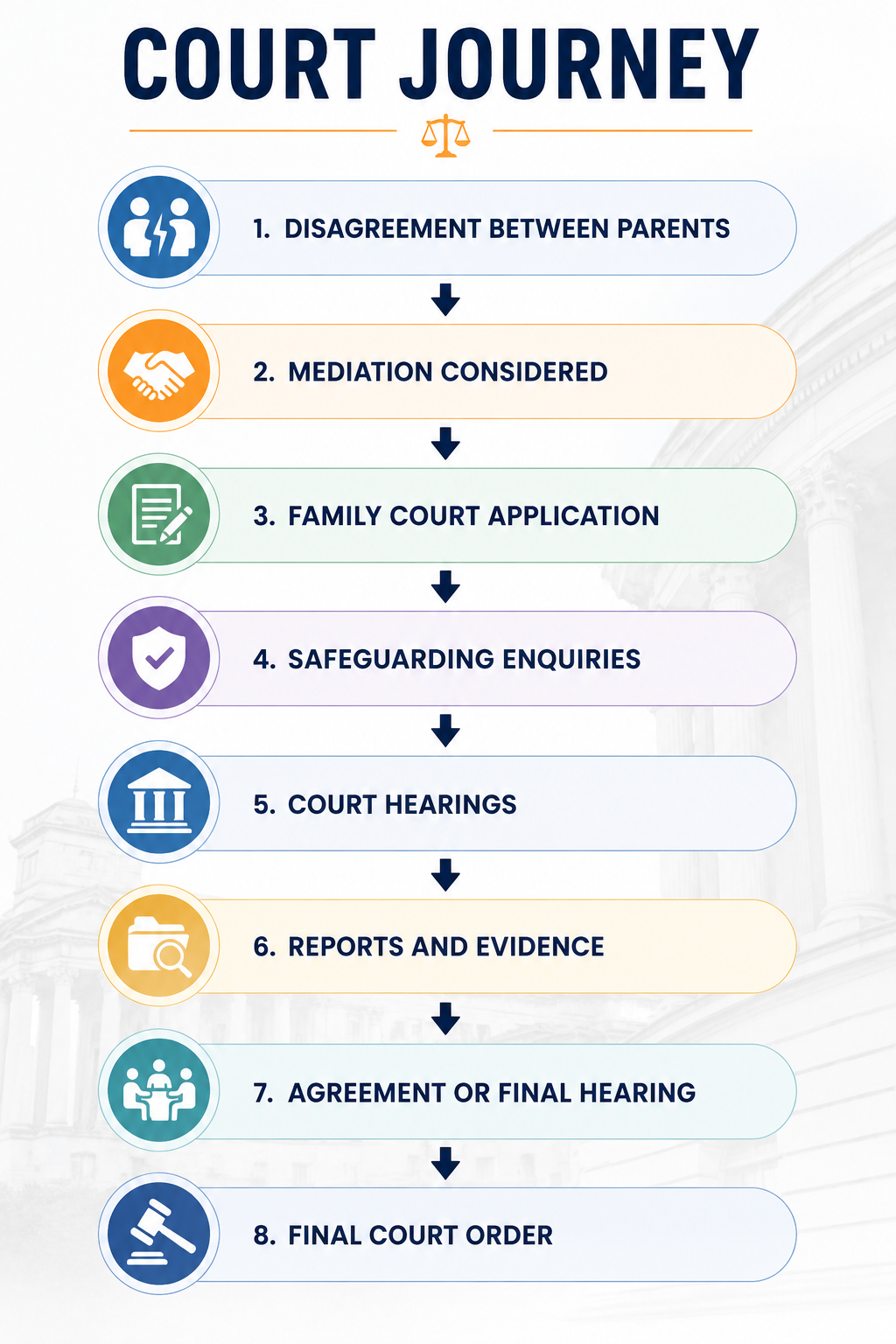
The court journey can be a lengthy process that many fathers will not be aware off. However, depending on the severity of your case it is worth noting the graphic below which illustrates the beginning, middle and end. Every stage plays an important role in achieving the desired result that is in the best interest of the child and will be considered to the fullest by the fathers solicitor. They are vastly experienced in this field and will ensure that you are informed every step of the way.
What are family court proceedings?
Family court proceedings are the legal process used to resolve disputes that parents are unable to settle themselves. While many people associate family court with divorce, the majority of children's cases focus on arrangements for children following separation. Proceedings may involve questions about where a child should live, how much time they should spend with each parent, whether a child can move abroad, schooling, medical treatment or other important decisions affecting their upbringing.
Contrary to popular belief, the court does not begin by taking sides. It approaches every case with an open mind and considers the evidence before making decisions. The judge is not there to decide who was responsible for the relationship ending. Nor is the court interested in deciding which parent is "better". Instead, every decision is made by asking one central question - What outcome is in the child's best interests? This principle forms the foundation of every decision made by the family court.
Why do parents end up in family court?
Most separated parents successfully agree arrangements without involving the courts. Many reach agreements through discussion, mediation or solicitor negotiations. However, court proceedings may become necessary where parents cannot agree on important issues or where there are safeguarding concerns. Examples include one parent refusing contact without good reason, disagreements over overnight stays, relocation disputes, concerns about domestic abuse, allegations of neglect, repeated breaches of existing court orders or disputes about parental responsibility.
It is important to understand that applying to court should usually be viewed as a last resort rather than the first step. Judges expect parents to make genuine attempts to resolve disagreements wherever it is safe and appropriate to do so.
Does family court favour mothers?
This is one of the most frequently asked questions. The simple answer is no. The law does not state that mothers should automatically become the primary carer, nor does it state that fathers should receive less time with their children. Modern family courts consider the individual facts of each case. The child's welfare always comes before the gender of either parent. Where it is safe and beneficial, courts generally recognise that children gain from having meaningful relationships with both parents. Every case is different. Decisions depend on evidence rather than assumptions.
The welfare principle
The most important concept in family law is the welfare principle. Whenever the court is making a decision about a child, the child's welfare becomes the court's paramount consideration. This means every decision is made by considering what will best promote the child's long-term wellbeing. Judges consider numerous factors including the child's emotional needs, physical needs, educational requirements, existing relationships, stability, age, understanding and any risk of harm.
The court also considers whether each parent is capable of meeting those needs both now and in the future. This is why evidence is so important during proceedings. Decisions are based on facts rather than opinions.
The welfare checklist
When making decisions under the Children Act 1989, judges consider what is commonly known as the welfare checklist.
This includes the child's wishes and feelings where appropriate, their emotional and physical needs, the likely effect of changes in circumstances, their age and background, any harm they have suffered or may be at risk of suffering, and each parent's ability to meet their needs. The welfare checklist provides a structured framework that helps judges reach balanced decisions rather than relying on personal opinion.
Before applying to court
In most private law children's cases, parents are expected to consider mediation before submitting an application. Mediation allows parents to meet with an independent mediator who helps them explore possible agreements. Many cases are resolved at this stage without the need for court proceedings. Where mediation is unsuitable, for example because of domestic abuse or other exemptions, parents may proceed directly to making an application. Even after proceedings have started, judges continue encouraging parents to reach agreement wherever possible. Successful agreements usually reduce stress, lower legal costs and allow parents to retain greater control over future arrangements.
How proceedings officially begin
Family court proceedings begin when one party files an application asking the court to resolve a dispute. The application explains what order is being requested and why court intervention is necessary. Once accepted, the court serves the documents on the other parent, who is given an opportunity to respond.
From this point onwards, the court takes control of the timetable. Deadlines are set, hearings are arranged and both parties are expected to comply with court directions. Ignoring court deadlines or failing to provide requested documents can slow proceedings and may negatively affect how the court views a party's conduct. In fact, the average time for private law children's cases is 41 weeks - Source: Ministry of Justice Family Court Statistics.